

Why Does Voltage Drop More Often in Summer? — And How an Automatic Voltage Stabilizer Fixes It
Ever turned on your air conditioner and watched the lights in your entire house dim at once? Or noticed that around evening time, your fan runs slower, lights flicker, or your computer randomly restarts without any reason?
That’s not a coincidence — and it’s not normal.
“Voltage drop” — also known as voltage sag — is one of the most common electrical problems in homes and factories across Thailand, and it gets significantly worse during summer. This article breaks down exactly what’s happening, why it’s dangerous, and how an Automatic Voltage Stabilizer solves the problem at its source.
What Is a Voltage Drop?
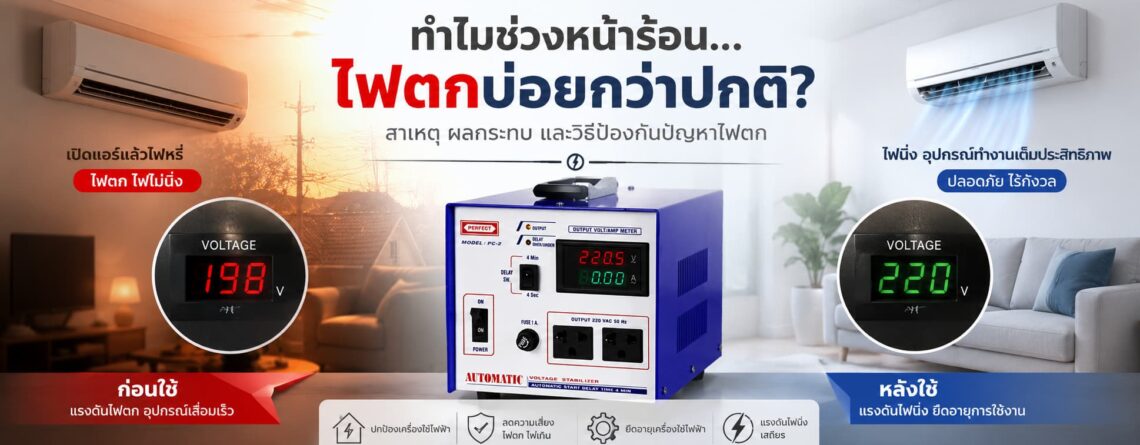
A voltage drop occurs when the electrical voltage in your system falls below the standard level, either temporarily or consistently. Thailand’s electrical standard is set at 220 volts (±10%).
When voltage drops, your supply may fall to 180–200 volts or lower — directly affecting the performance and lifespan of every appliance connected to your system.
Signs That Your Home Has a Voltage Drop Problem
- Lights dim throughout the house when large appliances turn on
- Fan spins slower than usual
- Lights flicker or appear dimmer, especially in the evening
- AC stutters or operates inconsistently
- Computer or router restarts on its own
- Water pump makes unusual noise or works harder than normal
- Appliances break down more frequently than expected
Why Does Voltage Drop Happen More in Summer?

Air conditioners affect voltage drop because each house uses them simultaneously.
1. Every Household Runs Their AC Simultaneously
During summer, temperatures in Thailand can reach 38–42°C, forcing every household to run air conditioning continuously. Peak hours — typically late afternoon to midnight — see electricity demand surge to its highest point of the year. The power grid absorbs this heavy load by allowing voltage levels to drop across distribution lines.
2. AC Units Draw Massive Current at Startup
Conventional (non-inverter) air conditioners pull 3–5 times their normal operating current in the split-second when the compressor starts — a phenomenon called Inrush Current. This causes an immediate voltage dip, especially in homes with older or undersized wiring.
3. Homes at the End of Power Lines Are Hit Hardest
The farther your home sits from the nearest electrical transformer, the lower the voltage you receive. During peak demand periods, end-of-line homes may receive as little as 190 volts — well below the safe standard — while homes near the transformer remain unaffected.
4. Nearby Factories and Large Buildings Compete for Power
If your home is located near an industrial estate or large commercial building running heavy machinery, those facilities draw significant power from the same distribution lines, pulling voltage down for everyone connected to that grid.
How Dangerous Is Voltage Drop? Don’t Mistake It for “Just Flickering Lights”
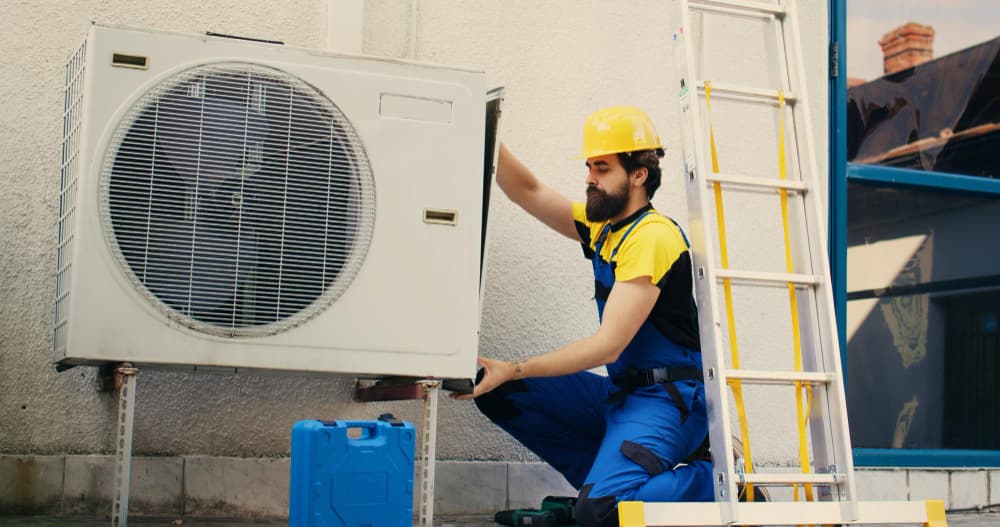
Voltage drop can unknowingly damage your air conditioner compressor.
This is where most people get it wrong. A voltage drop that looks like a brief dimming is silently damaging your appliances every single time it happens.
Real Damage Caused by Repeated Voltage Drops
AC Compressor Wears Out Early The compressor motor is designed to run at standard voltage. When voltage is low, the motor draws more current to maintain its output, causing excessive heat in the windings and accelerating deterioration. An AC that should last 10–15 years may fail in 5–7.
Water Pump Motor Burns Out Water pump motors running on low voltage are among the most vulnerable appliances in any home. Repeated voltage drops dramatically increase the risk of coil burnout — often an expensive repair or full replacement.
Computers and Servers Suffer Data Loss Sudden restarts from voltage drops can corrupt hard drives and damage Power Supply Units, leading to data loss and premature hardware failure.
Refrigerators and Kitchen Appliances Degrade Refrigerator compressors face the same stress as AC units. Unstable power delivery can also compromise cooling consistency, potentially causing food spoilage.
Factory Machinery Stops Production For industrial operations, voltage drops can cause machinery to shut down mid-process, disrupting production lines and generating losses that can run into tens or hundreds of thousands of baht.
What Is an Automatic Voltage Stabilizer — and How Does It Solve This?
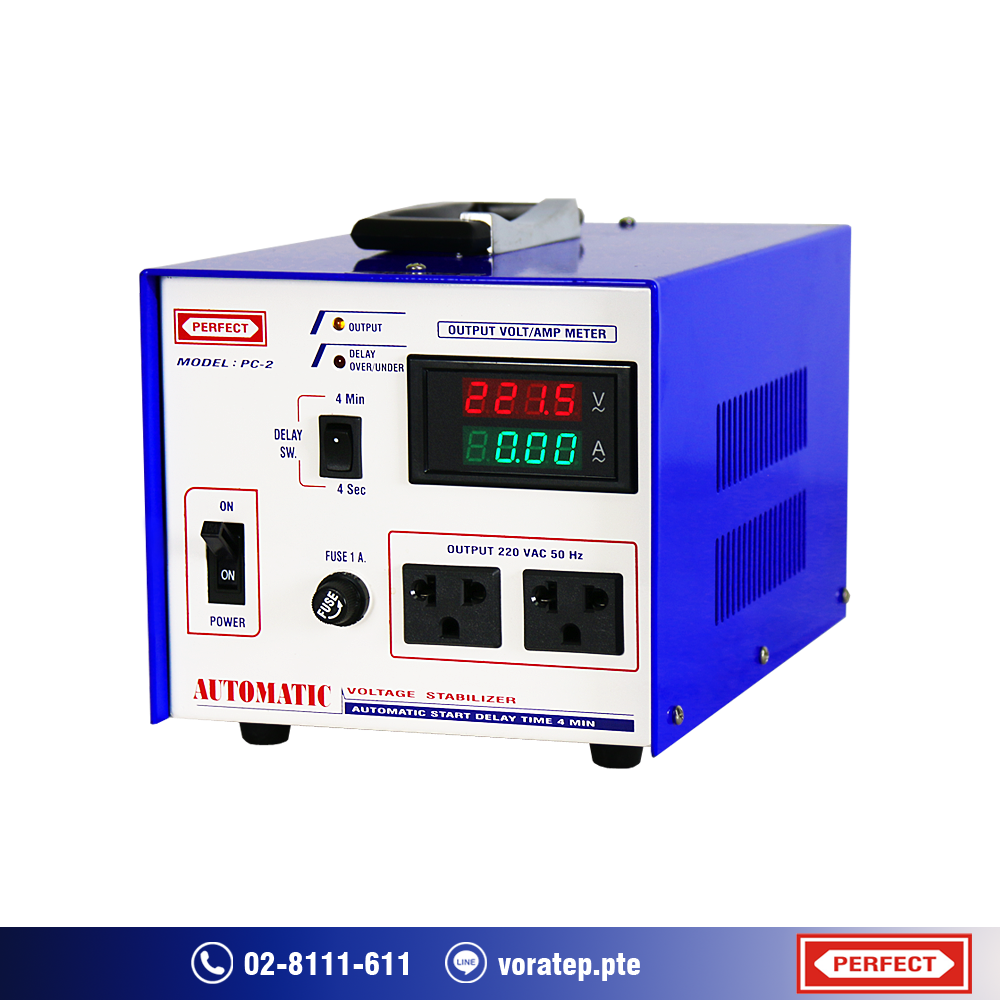
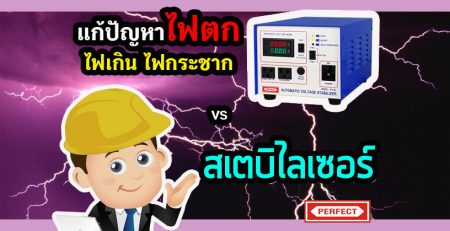
The PC-2 stabilizer, or automatic voltage regulator, protects against voltage drops, overvoltage, and power surges.
An Automatic Voltage Stabilizer (AVS) — also referred to as an Automatic Voltage Regulator (AVR) — is a device that maintains a constant, stable output voltage regardless of how much the incoming supply fluctuates.
How It Works
The Stabilizer continuously monitors incoming voltage in real time. If it detects a drop below the set threshold, the system automatically boosts the voltage back to 220 volts. If voltage spikes too high, it brings it back down to a safe level. This entire process happens in milliseconds, ensuring that connected equipment receives clean, stable power at all times.
Automatic Voltage Stabilizer vs. Standard Surge Protector
| Feature | Automatic Voltage Stabilizer | Standard Surge Protector |
|---|---|---|
| Maintains constant voltage | ✅ Continuously active | ❌ Not available |
| Protects against voltage drop | ✅ Auto-boosts voltage | ❌ Not available |
| Protects against overvoltage | ✅ Auto-reduces voltage | ✅ Cuts circuit when exceeded |
| Surge protection | ✅ | ✅ |
| Suitable for motors & AC units | ✅ Excellent | ❌ Not suitable |
| 24/7 continuous operation | ✅ | ✅ |
A standard surge protector only reacts to spikes — it does nothing when voltage drops. A Voltage Stabilizer actively corrects both directions, making it the comprehensive solution for unstable power environments.
Who Needs a Voltage Stabilizer?
Homes and Residences
- Homes located at the end of power distribution lines
- Any home with multiple AC units or a large water pump
- Households with sensitive or high-value electronics
Factories and Industrial Operations
- Any facility running motors or electric machinery
- Production lines requiring continuous, uninterrupted operation
- Server rooms and IT infrastructure
- Precision equipment such as CNC machines, welding equipment, or industrial printers
How to Choose the Right Automatic Voltage Stabilizer
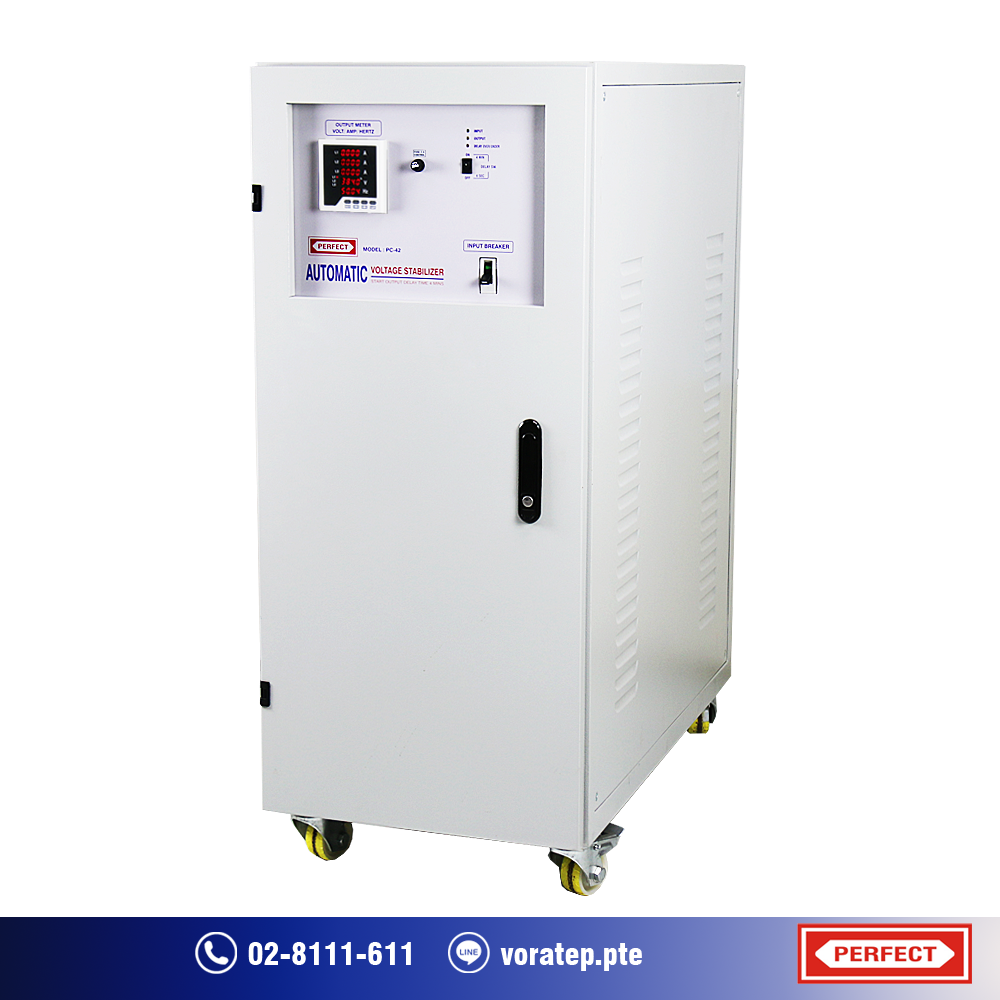
The PC-42 3-Phase stabilizer, or automatic voltage regulator, protects against voltage drops, overvoltage, and power surges.
Step 1 — Calculate Your Total Load
Add up the wattage of all appliances you want to protect, then add a 20–30% buffer to account for motor Inrush Current.
Example: 1-ton AC (1,200W) + Water pump (500W) + Refrigerator (150W) = 1,850W → Choose a Stabilizer rated at 3 kVA or higher
Step 2 — Check the Input Voltage Range
A quality Stabilizer should support a wide input range — ideally 140–260 VAC — so it continues to function even during severe voltage drops.
Step 3 — Consider Response Time
Faster response time means better protection, particularly for sensitive electronics and precision machinery.
Step 4 — Choose the Right Type for Your Application
- Single Phase — Ideal for homes and small offices
- Three Phase — Designed for factories and commercial facilities with 3-phase power
- Servo Motor Type — High precision, best for sensitive machinery, medical equipment
- Relay Type — Cost-effective, suitable for general household use, water pump, air conditioner, motor
How to Check If Your Home Has a Voltage Drop Problem
Simple Self-Check Methods
- Watch your lights — If lights dim every time you turn on the AC or water pump, that’s a clear voltage drop signal.
- Log the timing — If it only happens between 5–9 PM, the problem is likely peak-hour grid overload. If it happens throughout the day, suspect internal wiring issues.
- Use a Voltmeter — Measure voltage at your wall outlet. Normal range: 210–230 volts. If readings frequently fall below 200 volts, immediate action is needed.
Summary: Don’t Let Voltage Drops Destroy Your Expensive Equipment
Voltage drops in summer are a solvable problem — and an Automatic Voltage Stabilizer is the most direct and effective solution available. It doesn’t just provide temporary protection; it actively corrects your power supply continuously, so your appliances always operate under the conditions they were designed for.
The sooner you address it, the more you save in repair costs, replacement costs, and lost productivity.
What you should do right now:
✅ Check whether your home matches any of the symptoms described above
✅ Measure your voltage with a Voltmeter during evening peak hours
✅ Consult a specialist to select the right Stabilizer for your specific setup
Have questions about voltage drop — or want to know which Automatic Voltage Stabilizer is right for your home or factory?
Our team of electrical specialists is ready to advise you, completely free of charge.


 02-8111-611-5, 086-322-7193
Perfect Thai Electric Co., Ltd. Your trusted specialist in Automatic Voltage Stabilizers and high-quality electrical equipment.